SiFive is a semiconductor IP company headquartered in Santa Clara, California. As a key driver of the RISC-V movement, it has attracted significant market attention. The company was founded in 2015 by UC Berkeley researchers Krste Asanović, Yunsup Lee, and Andrew Waterman—who are also the original inventors of the RISC-V instruction set architecture. This gives SiFive a distinct advantage over typical startup IP companies in terms of technical credibility, industry influence, and ecosystem leadership.
SiFive Company Overview
Business Model & Market Positioning
From a business model perspective, SiFive is a typical fabless semiconductor IP company. It does not manufacture chips but focuses on designing processor core IP, which is licensed to customers for integration into their own SoCs. These chips are then produced by foundries such as Taiwan Semiconductor Manufacturing Company (TSMC) and Samsung.
This model is similar to Arm Holdings, with revenue primarily generated from licensing fees and royalties. The key difference is that Arm operates on a proprietary architecture, while SiFive is built on the open-source RISC-V architecture, offering customers greater flexibility and customization. This advantage has helped SiFive rapidly attract customers across data centers, AI, automotive, and embedded markets.
As of March 2026, the company has around 504 employees. CEO Patrick Little leads the company, with co-founder Krste Asanović as Chief Architect, Yunsup Lee as CTO, and Andrew Waterman as Chief Engineer.
SiFive’s product portfolio has expanded into high-performance computing, AI optimization, embedded systems, and automotive applications, clearly moving upmarket:
- The Performance series (P-series) targets high-performance and data center workloads, with flagship products such as P870 and P550, competing with Arm Neoverse and x86 architectures.
- The Intelligence series (X-series) focuses on AI workloads, integrating scalar, vector, and matrix computing capabilities, making it suitable for edge AI and inference.
- The Essential series (E-series) targets area- and power-sensitive applications such as MCUs, IoT, and edge devices.
- The Automotive series focuses on ADAS and autonomous driving SoCs, featuring ISO 26262 certification and lock-step execution.
| Series | Positioning | Applications |
|---|---|---|
| Performance (P-series) | High-performance cores | Data centers, server workloads |
| Intelligence (X-series) | AI-optimized cores | Edge AI, inference |
| Essential (E-series) | Area-optimized embedded cores | MCU, IoT, edge devices |
| Automotive | Safety-certified cores | ADAS, autonomous driving |
With the rise of AI inference, SiFive holds a strong position in this segment, particularly in edge computing, while also playing a supporting role in data center training chips. Leveraging RISC-V vector extensions (RVV), strong PPA (performance, power, area), and customization flexibility, SiFive enables chip designers to build specialized AI accelerators with low power and small die size—bridging the gap between microcontrollers and high-power GPUs.
Capital Market Revaluation
SiFive’s recent development reflects a reassessment of its strategic value. On April 9, 2026, the company announced the completion of a $400 million Series G funding round, reaching a valuation of $3.65 billion. The round was led by Atreides Management, with participation from Apollo Global Management, NVIDIA, Point72, and T. Rowe Price. Total funding has reached $795 million.
More importantly, SiFive has been adopted by 8 of the world’s top 10 semiconductor companies, with cumulative IP shipments exceeding 10 billion cores. This demonstrates that the company has reached a stage of proven mass production, broad customer adoption, and strong capital market validation.
| Round | Investor | Round Size (m) | Funding Date |
|---|---|---|---|
| Series G | Prosperity7 Ventures | 400.00 | Apr 09, 2026 |
| Series G | Sutter Hill Ventures LLC | 400.00 | Apr 09, 2026 |
| Series G | Atreides Management LP | 400.00 | Apr 09, 2026 |
| Series G | NVIDIA Corp. | 400.00 | Apr 09, 2026 |
| Series G | T. Rowe Price Investment Management, Inc. | 400.00 | Apr 09, 2026 |
| Series G | Apollo Management LP | 400.00 | Apr 09, 2026 |
| Series G | Point72 Ventures Partners LLC | 400.00 | Apr 09, 2026 |
| Series F | Ibex Investors LLC | 175.00 | Mar 16, 2022 |
| Series F | Coatue Management LLC (Private Equity) | 175.00 | Mar 16, 2022 |
| Series E | Prosperity7 Ventures | 90.00 | Aug 11, 2020 |
| Series E | Sutter Hill Ventures LLC | 90.00 | Aug 11, 2020 |
| Series E | Intel Capital Corp. | 90.00 | Aug 11, 2020 |
| Series E | Western Digital Capital LLC | 90.00 | Aug 11, 2020 |
| Series E | Spark Capital Partners LLC | 90.00 | Aug 11, 2020 |
| Series E | QUALCOMM Ventures | 90.00 | Aug 11, 2020 |
| Series E | OUP Management Co. LLC | 90.00 | Aug 11, 2020 |
| Series E | SK hynix, Inc. | 90.00 | Aug 11, 2020 |
| Series D | Sutter Hill Ventures LLC | 65.43 | Jun 06, 2019 |
| Series D | Spark Capital Partners LLC | 65.43 | Jun 06, 2019 |
| Series D | QUALCOMM Ventures | 65.43 | Jun 06, 2019 |
| Series D | OUP Management Co. LLC | 65.43 | Jun 06, 2019 |
| Series D | Zepp Health Corp. | 65.43 | Jun 06, 2019 |
| Series D | Chengwei Capital Co. Ltd. | 65.43 | Jun 06, 2019 |
| Series C | Sutter Hill Ventures LLC | 50.61 | Apr 02, 2018 |
| Series C | Intel Capital Corp. | 50.61 | Apr 02, 2018 |
| Series C | Western Digital Capital LLC | 50.61 | Apr 02, 2018 |
| Series C | Spark Capital Partners LLC | 50.61 | Apr 02, 2018 |
| Series C | OUP Management Co. LLC | 50.61 | Apr 02, 2018 |
| Series C | Zepp Health Corp. | 50.61 | Apr 02, 2018 |
| Series C | Chengwei Capital Co. Ltd. | 50.61 | Apr 02, 2018 |
| Series C | SK Telecom Americas Innopartners | 50.61 | Apr 02, 2018 |
| Series B | Sutter Hill Ventures LLC | 8.50 | May 08, 2017 |
| Series B | Spark Capital Partners LLC | 8.50 | May 08, 2017 |
| Series B | OUP Management Co. LLC | 8.50 | May 08, 2017 |
| Series A | Sutter Hill Ventures LLC | 5.06 | Sep 04, 2015 |
Competitive Moat: Architecture Control and Customization
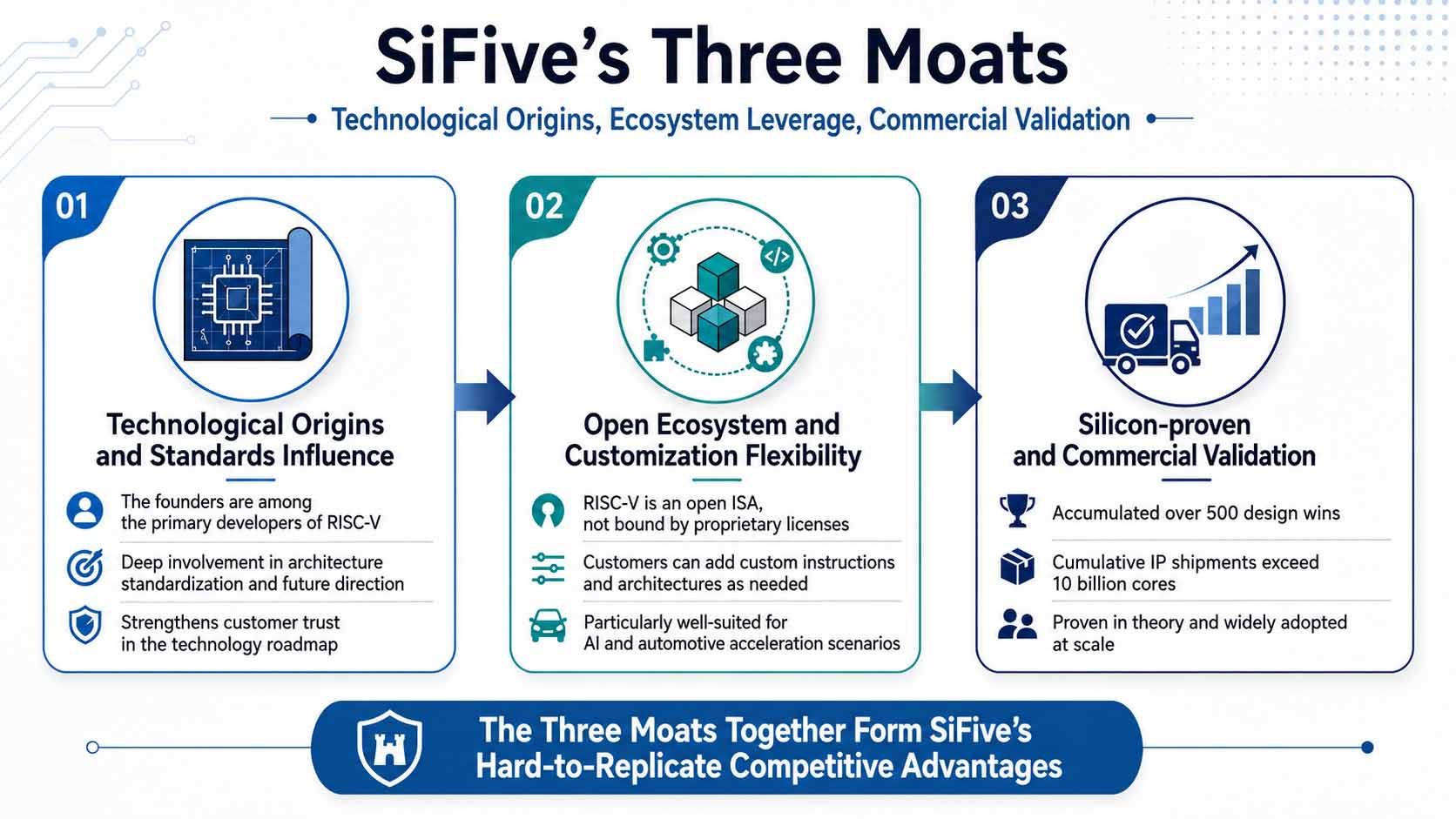
SiFive’s competitive moat is built on three key pillars:
- Control of core architecture – Its founders are the inventors of RISC-V, giving SiFive influence over architecture evolution and strengthening customer trust.
- Ecosystem leverage – As an open ISA, RISC-V allows customers to add custom instructions without being locked into proprietary licensing models, making it especially attractive for AI and automotive applications.
- Commercial validation – With over 500 design wins and more than 10 billion cores shipped, SiFive has proven its scalability and reliability.
SiFive’s collaboration with NVIDIA further strengthens its strategic position. Its RISC-V CPU cores are deeply integrated with NVIDIA’s ecosystem—supporting CUDA at the software level and NVLink Fusion at the hardware level. This enables high-bandwidth, low-latency connectivity, overcoming traditional PCIe limitations.
As a result, cloud providers and system vendors can move beyond x86 and Arm architectures, integrating custom RISC-V CPUs into NVIDIA’s “AI Factory” infrastructure. This positions SiFive as a potential key player in next-generation AI infrastructure.
Why Did NVIDIA Invest in SiFive?
NVIDIA’s decision to invest in SiFive at this stage is driven by several factors. One of the primary motivations is to hedge against Arm Holdings. NVIDIA has historically relied heavily on Arm across products such as the Grace CPU, automotive SoCs, and the Tegra lineup. However, after its failed acquisition of Arm in 2022, the relationship shifted to a standard supplier–customer dynamic. If Arm continues to raise licensing thresholds or strengthen its pricing power, NVIDIA’s bargaining position and margins could be pressured. Investing in SiFive therefore provides an alternative path beyond Arm.
In addition, SiFive helps fill a key gap in NVIDIA’s AI factory strategy—CPU capability. NVIDIA’s long-term goal is to deliver a fully integrated infrastructure combining CPUs, GPUs, DPUs, and interconnect technologies. If SiFive can supply RISC-V CPU IP, NVIDIA could offer customized CPU solutions alongside its accelerators and interconnect stack in certain use cases. At the same time, NVIDIA aims to gain early exposure to the open-source RISC-V ecosystem, which has been expanding rapidly in regions such as China and India. Without participation, NVIDIA risks losing influence over a potentially critical computing architecture.
Finally, there is the financial upside. Investing in a company valued at $3.65 billion with IPO potential offers meaningful return opportunities.
How Two Failed Acquisitions Reshaped Today’s Landscape
Looking at the broader timeline, the relationships among SiFive, Intel, Arm, and NVIDIA have been complex. In 2021, Intel attempted to acquire SiFive for over $2 billion to strengthen its Intel Foundry Services (IFS) strategy and architecture roadmap, but the deal did not materialize. Earlier, between 2020 and 2022, NVIDIA attempted a $40 billion acquisition of Arm, which ultimately failed due to global regulatory pressure.
By 2026, both Intel—unable to acquire SiFive—and NVIDIA—unable to acquire Arm—are once again confronting the rise of RISC-V. The semiconductor industry often sees emerging technologies or companies disrupt markets rapidly. What initially appears to be a niche alternative can, due to power dynamics, licensing conflicts, and regulatory constraints, evolve into a dominant force within a few years.
In summary, SiFive can be viewed as a critical infrastructure option in the post-Arm era. Its value lies in its architectural origin and legitimacy, proven commercialization and large-scale deployment, and its strategic importance to major industry players. As competition intensifies in data center CPUs, AI infrastructure, and open architectures, SiFive—founded by the creators of RISC-V—is increasingly gaining attention in capital markets.
